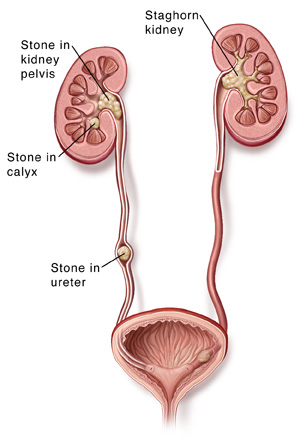
Kidney stones
Nephrolithiasis, also known as kidney stones, is a prevalent medical condition that requires immediate attention to prevent severe kidney damage. In the Western Medicine, renal stones are well-thought-out as a case for inferential treatment (surgery, laser, etc.). However, natural and especially homeopathic remedies can break down and melt kidney stones, prevent the building of new stones, or force them to leave your body through the urinary tract without medical intervention. In reality, homeopathic and other natural remedies have revealed the most notable outcomes in healing the persistent predisposition on the way to the development of nephrolithiasis. The most common homeopathic remedies for kidney stones are Lycopodium, Hydrangea, Berberis, Cantharis, and Sarsaparilla.
In homeopathy, the correct selection of the remedies is the key to success.
Different patients with “similar” kidney stone disease from a western perspective would be treated using different homeopathic remedies according to what we call in homeopathy “CONSTITUTION.” Even the side on which kidney stones develop makes a difference for the correct medicine.
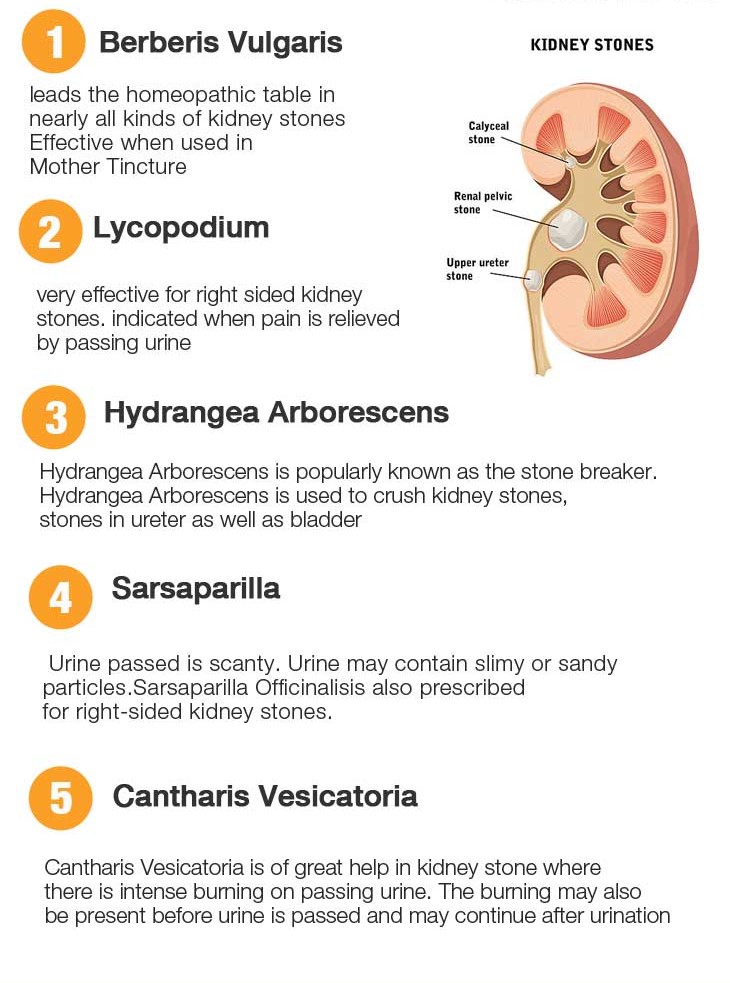
Below, you can find a very short and simple example of choosing homeopathic medicines for renal stone syndrome. This is not the homeopathic medicine manual, so please don’t use it as a direction for self-treatment
If Nephrolithiasis developed in the left kidney, most likely the right remedies will be either Berberis or Hedeoma
- Berberis is one of the most famous homeopathic remedies for kidney stones that are found in the left kidney. An exceptional symptom that makes homeopaths prescribe it is a pain in the left side of the lower back, which radiates to the front side of the stomach all the way down to the pubic and genital areas. The pain may be sharp or resemble the sensation of cutting or stitching. It usually gets worse with movement or juddering. Urine’s color is usually light or dark yellow and may hold deposits. The kidneys are sensitive to palpation.
- If urine contains white or light-yellow sand, Hydrangea is an excellent homeopathic remedy for kidney stones. If you find a white or yellow deposit, Hydrangea is the best homeopathic remedy. Hydrangea is well-known as a stone breaker. We use it to break and crush renal stones in the kidney, urethra, or bladder. Discomfort and pain in the kidneys are common in such patients. Urine may also contain blood.
For kidney stones localized on the right side, Lycopodium and Cantharis are more effective
- When stones develop in the right kidney, people commonly use Lycopodium for their treatment. Lycopodium is an outstanding selection of homeopathic remedies for nephrolithiasis healing on the right side. A patient that needs this remedy is experiencing pain in the right side of the lower back and in the lower right part of the stomach. The pain increases before urination. Urine is usually scanty. The pain diminishes after urination. Urine may contain red residues. Sometimes urine may be pus-filled, turbid, and pale.
- Cantharides—Burning is a major symptom. Cantharis is one of the most commonly used homeopathic remedies for various diseases of the urinary tract, including renal stones, particularly when patients experience severe burning during urination. This feeling may appear before urination and last for 20 or more minutes after. Another important symptom for selecting Cantharis is kidney pain accompanied by recurrent urges to urinate. Bladder tenesmus may manifest as kidney stones in patients who will benefit from Cantharis. In those cases, the urge to urinate is persistent, along with insufficient satisfaction after urination. It’s common to experience a residual sensation in the bladder. A sample of urine may contain jelly-like elements.
The potency of the homeopathic medicines is crucial when using them for kidney stones. The major rule about the potency is
- The younger the patient, the lower the potency.
- If the disease is acute (first symptoms arose no more than 2–3 months ago), use lower potency. For chronic cases use high potency
- If the disease is acute (first symptoms arose no more than 2–3 months ago), use lower potency. For chronic cases use high potency
Frequently Asked Questions about Homeopathic Treatment for Nephrolithiasis.
-
Why do I suffer from renal stones?
The urinary tract consists of kidneys, the urethra, and the bladder. Kidneys are very important organs that screen, filter, and clean blood, eliminating waste, toxins, and excess fluids from the system. Urine is the fluid that the kidneys filter. Urine originates in the kidneys, travels through the ureters, and ultimately gathers in the bladder. The hard pieces of minerals developed in kidneys or bladders are known as nephrolithiasis.
-
What types of kidney stones are found?
There are principally five kinds of stones, including
- uric acid stones
- struvite stones (usually developed in individuals that suffer from chronic UTI)
- calcium stones (developed from different salts of calcium: oxalates and phosphates)
- staghorn stones are the same as struvite stones, but when they are big, we call them staghorn stones
- cystine stones, which have a genetic nature and run in families in which members suffer from cystinuria
-
What makes an individual predisposed to nephrolithiasis?
The risk factors for renal stone development are:
- High protein food consumption
- High Calcium diet
- High Oxalate intake (tomatoes, apples)
- Chronic Dehydration
- Chronic UTI
- Overweight and Obesity
- Genetic predisposition to Stones
- Cystinuria
-
How does nephrolithiasis develop?
Stones develop when the amount of crystal-forming ingredients in urine, such as calcium, phosphates, uric acid, and/or oxalates, increases.
-
Which kidney stones lead to severe pain?
Tiny kidney stones may not cause any pain and may stay in kidneys, showing no symptoms whatsoever. In such cases, ultrasound or other studies often unintentionally uncover nephrolithiasis. However, large stones usually lead to severe pain, which often requires narcotics even for temporary relief. Small stones may also cause acute, sharp pain when they are passing through the urinary system, injuring the internal layer of the bladder or urethra.
-
Which tests prove the diagnosis of nephrolithiasis?
The most common tests confirming kidney stones are:
- Ultrasound of the pelvic area
- X-ray with contrast,
- IPV—Intravenous pyelogram
- CT
-
Can nephrolithiasis lead to kidney diseases?
Due to the permanent urine flow block, there are probabilities of the development of chronic kidney illnesses.
-
What is renal colic?
The medical term renal colic refers to severe pain caused by kidney stones. This pain is usually localized in the mid-back or flank area, as well as in the lower stomach area.
-
How effective is holistic medicine for kidney stones?
Homeopathic remedies are effective for nephrolithiasis, especially if stones are small and don’t lead to urine retention or significant hydronephrosis.
-
Can homeopathic remedies melt kidney stones down?
Yes, homeopathic remedies are used to melt down renal stones as long as they are small and consist of phosphates and oxalates.
Stones of size up to 9 mm usually may dissolve when using the proper homeopathic medicines. For the larger size of kidney stones, homeopathic medicine is also one of the best choices for natural treatments in combination with regular western treatment from a urologist.
-
Can an excess of uric acid lead to nephrolithiasis?
Yes, a high concentration of uric acid in the blood is one of the most common reasons for kidney stone disease.
-
Can holistic medicine help in cases of renal colic?
Yes, holistic medicine in general and homeopathy and acupuncture in particular help to reduce pain during renal colic and to push small stones out. But remember that the renal colic that causes urine retention requires surgical intervention.
The natural treatment for Kidney Stones in Philadelphia
Philadelphia Holistic Clinic is the #1 naturopathic clinic in Philadelphia and the nearest suburbs based on patients’ reviews and professional rewards. At the clinic, Medical Doctor Victor Tsan, along with the team of holistic practitioners, successfully uses homeopathy and acupuncture for kidney stone treatment, and in many cases, our patients are able to avoid surgery because holistic medicine not only relieves the pain but, in many patients, prevents new stone development and causes the melting of existing stones.
To find out if holistic medicine is the right choice for you, contact us at (267) 403-3085 or use our online application to schedule an appointment for your first evaluation.
You must be logged in to post a comment.